

Molecular Microbiology BIOR63
15 credits
Course description
This course focuses on the molecular basis of bacterial, structure, physiology, genetics, and regulatory mechanisms. Bacteria make up the foundation of the biosphere and sustain all life on earth. They have the amazing ability to grow in extreme conditions and to grow slowly or rapidly. Current estimates of the number of bacterial species range from 1 to 1000 million. The realization of the vastness of bacterial diversity and the development of novel experimental techniques have propelled molecular microbiology into a new era of investigation This course provides insights into how genes are organized and regulated in bacteria and in their viruses. The course comprises molecular biology of genes, proteins, multicomponent protein complexes, and other biomolecules that provide structure and perform the organism's functions. The use of genetic engineering and modern techniques such as transcriptomics, proteomics and sequence analysis are included in the course. The experimental part focus on the model organisms, Bacillus subtilis, Escherichia coli and Streptomyces coelicolor.
Molecular aspects of the following subjects are covered:
- Macromolecular synthesis (chromosome structure, cell division and its control).
- Genes and genetic elements (plasmids, conjunction, transformation, phage biology, recombination and repair, regulation of gene expression, global regulatory mechanisms, stochastic effects in gene expression).
- Development (spore formation).
Aims
To provide students with the opportunity to be exposed to the current state of understanding of the molecular biology of bacteria. Upon successful completion of the course the students shall have acquired the following knowledge and understanding:
- established an understanding of the principles underlying the genetics of bacteria.
- be able to describe molecular genetic processes in bacteria.
- be familiar with the techniques of molecular genetics and their uses and limitations.
- developed practical skills in applying molecular techniques.
- to develop practical skills in data interpretation, communication as well as interpersonal and team-working skills.
- to acquire intellectual ability and practical skills to work productively in a commercial setting, institute, or university laboratory on different aspects concerning molecular microbiology.
Teaching
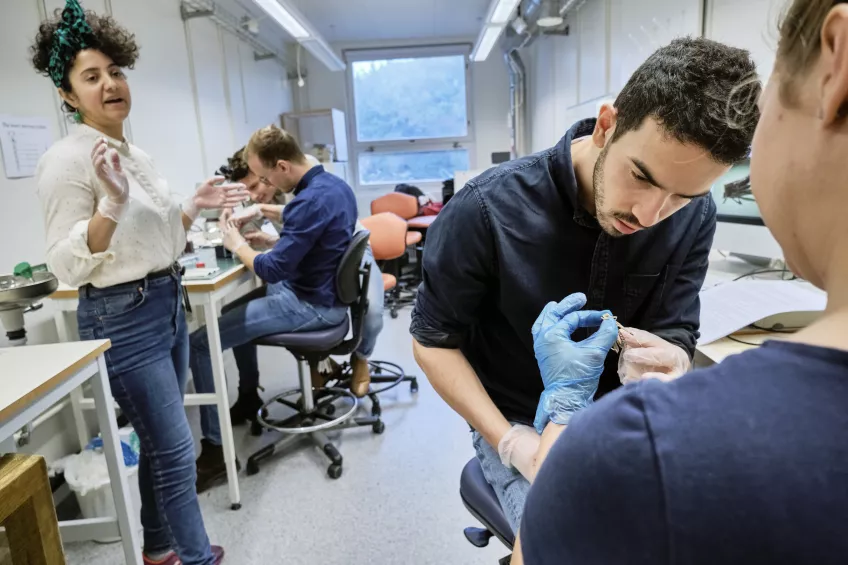
The aims of the course will be achieved through a combination of lectures, tutorials, group discussions and practical classes. A major part of the practical work involves an inquiry-based laboratory project. The creation and isolation of specific mutants is a cornerstone of bacterial genetics. During this part of the course the student will do a project that involves specific or random mutagenesis techniques. The students will gain an understanding of genetics concepts and molecular biology techniques by using them in the context of a research project. Moreover, they will learn how to analyze and communicate the results of a multi-step project. An important aspect of the project is that the students are expected to maintain a detailed laboratory notebook to record protocols and data as required.
Examination and Grades
The course examination includes a written exam, laboratory part, research project, and seminar assignments. The grades are Pass with distinction, Pass, and Fail. A passing grade on the course requires a passing grade on the written exam. A student wishing to complement the ordinary grade with an ECTS grade must file a request to the course organizer at the start of the course. A resit examination in the same format as the main examination will be provided for those students who are unsuccessful in the first examination.
Beyond the course
This course is an important part of the "The microbiology master's programme" which provides an education and training that is highly competitive and very suitable for employment within many sectors of industry and society. The program encompasses two years of full time studies.
Autumn period 2
Full-time, on campus, in English
Application
Course literature 2025
Snyder and Champness Molecular Genetics of Bacteria, 5th edition by Henkin and Peters, Wiley-Blackwell, (2020) ISBN: 978-1-555-81975-0
Schedule
The latest schedule for the course Molecular Microbiology in the schedule software TimeEdit.
Evaluations
You find the latest evaluation on our web page with course evaluations.
Course coordinator
Questions?
Therese Reber, study advisor, molecular biology
Telephone: +46 46 222 83 19
Email: molbiol_master [at] biol [dot] lu [dot] se